
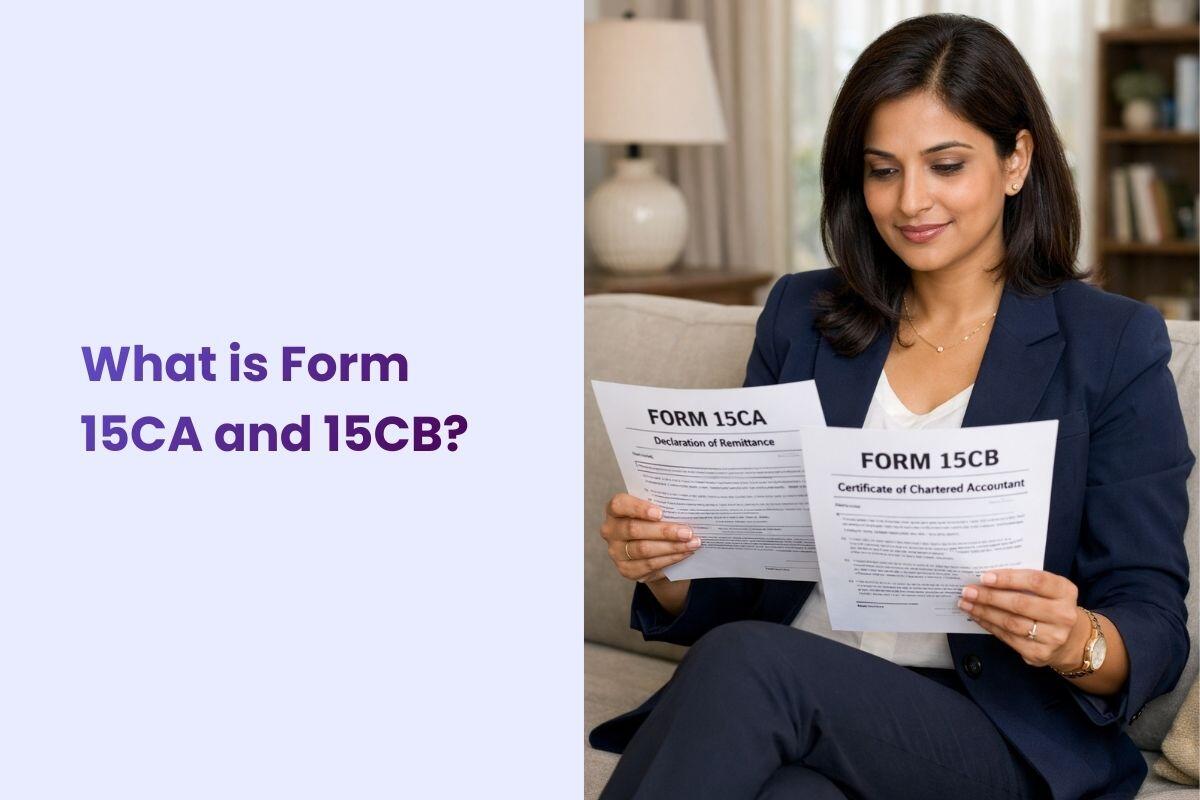
If you're an NRI looking to transfer money from your Indian bank account to your overseas account, your bank will likely ask for Form 15CA and Form 15CB.
These compliance documents are required under the Income Tax Act when you remit funds from India abroad. Understanding when you need them, which part to file, and how to complete the process correctly can save you from delays, penalties up to ₹1 lakh, and unnecessary complications with your bank.
What Are Form 15CA and Form 15CB?
Form 15CA is a declaration you submit to the Income Tax Department before making foreign remittances from India, confirming that applicable taxes have been deducted. Form 15CB is a Chartered Accountant's certificate validating your remittance complies with Indian tax laws and DTAA provisions, required when remittances exceed ₹5 lakh annually.
Banks will not process foreign remittances without these forms when required. Even for NRO account to NRE account transfers within India, banks demand these forms as compliance under Section 195 of the Income Tax Act governing TDS for NRI payments.
When Do NRIs Need to File Form 15CA and 15CB?
For remittances below ₹5 lakh annually, file only Form 15CA Part A without CA certificate. Once aggregate remittances exceed ₹5 lakh in the financial year, obtain Form 15CB from a Chartered Accountant and file Form 15CA Part C. The threshold includes all transfers to the same recipient during the year.
NRIs need these forms when repatriating rental income, FD proceeds, property sale amounts, or transferring NRO savings to overseas accounts. According to FEMA rules for NRI, you can repatriate up to USD 1 million annually from NRO accounts, but tax compliance through these forms remains mandatory.
Banks require Form 15CA and 15CB even for NRO to NRE transfers within India because tax obligations are based on your non-resident status, not physical money location. The Income Tax Department tracks these fund movements to ensure proper tax collection.

Understanding the Four Parts of Form 15CA
Form 15CA is divided into four parts, and you must choose the correct part based on your remittance amount and tax status. Filing the wrong part can cause delays and require refiling.
Part A applies when your remittance or aggregate remittances during the financial year don't exceed ₹5 lakh and the amount is chargeable to tax. This part requires basic information about the remitter, recipient, and remittance details. No CA certificate is needed for Part A.
Part B is used when remittances exceed ₹5 lakh and you have obtained a certificate or order from the Assessing Officer under Section 195(2), 195(3), or 197 of the Income Tax Act. This scenario typically applies if you've applied for and received a lower deduction certificate similar to Form 13 for nil or reduced TDS. Part B doesn't require Form 15CB since you already have an official certificate from tax authorities.
Part C is the most common for substantial NRI remittances. You file this part when remittances exceed ₹5 lakh during the financial year and you need to attach Form 15CB from a Chartered Accountant. The CA certifies the tax compliance before you can file Part C.
Part D applies when your remittance is not chargeable to tax under the Income Tax Act. This might apply to certain capital repatriation or tax-free transactions. However, Part D still requires filing unless your transaction falls under the specific exemption list in Rule 37BB.
Who Needs Form 15CB and How to Get It?
Form 15CB becomes mandatory when remittances exceed ₹5 lakh annually without an Assessing Officer's certificate. The CA verifies fund sources, checks taxability under Income Tax Act, determines applicable TDS rates considering DTAA provisions, and confirms TDS payment. For DTAA benefits, provide your Tax Residency Certificate (TRC) and Form 10F to the CA.
Most CAs charge ₹2,000-₹10,000 for Form 15CB, taking 2-4 days once you submit bank statements, TDS challans, property documents if applicable, and TRC with Form 10F for DTAA claims. The CA files electronically using Digital Signature Certificate, providing an acknowledgement number for your Form 15CA Part C filing.
How to File Form 15CA Online
Gather required documents: PAN card, bank details, payment information, TDS challans, and Form 15CB acknowledgement (for Part C). Log in to www.incometax.gov.in, navigate to e-File > Income Tax Forms > Form 15CA, and select the appropriate part.
For Part A or D, directly fill remitter, remittee, and remittance details. For Part C, add your CA's details and enter the Form 15CB acknowledgement number. Preview carefully, then verify using DSC or EVC (Aadhaar OTP, net banking, or bank verification). Download the acknowledgement immediately and submit to your bank before remittance processing.
Exemptions Under Rule 37BB
Not all foreign remittances require Form 15CA and Form 15CB. Rule 37BB of the Income Tax Rules specifies 33 types of payments that are exempt from this requirement.
The key exemption applies to remittances made by individuals that don't require prior Reserve Bank of India approval under FEMA regulations. This includes transactions covered under the Liberalised Remittance Scheme (LRS) for personal purposes like travel, education abroad, maintenance of relatives, and medical treatment.
Other exempt categories include payments for imports of goods (subject to conditions), investment in equity shares or debt securities by Indian companies abroad, and specific government-related transactions. However, banks may still ask for these forms as part of their internal compliance even if your transaction technically falls under an exemption.
The complete list of exempt transactions is available in Rule 37BB, Schedule III of the Income Tax Rules. If your transaction qualifies for exemption, you don't need to file any part of Form 15CA or obtain Form 15CB. Check with your bank whether they accept the exemption or have additional internal requirements.
Penalties and Consequences of Non-Compliance
Section 271-I imposes ₹1 lakh penalty per form for non-filing or incorrect information in Form 15CA or Form 15CB. Penalties apply whether you fail to file completely or provide inaccurate details. Banks refuse to process remittances without proper forms and may report non-compliant transactions to tax authorities, potentially triggering inquiries or blocking transactions until documentation is provided. Plan ahead with 2-4 days for processing once forms are ready, or weeks if corrections are needed.
Bank Requirements vs Legal Requirements
Banks often require Form 15CA and 15CB for NRO to NRE transfers as internal compliance, even when legal requirements may differ. They interpret these as remittances to non-residents for risk management purposes. Public sector banks tend to be more rigid than private banks, though policies vary. When encountering conflicting information, consult your bank's NRI services desk directly for their specific requirements.
Common Mistakes to Avoid
Filing the wrong Form 15CA part is common. Check cumulative annual remittances to ensure you file Part A (under ₹5 lakh) or Part C (above ₹5 lakh) correctly. Missing TDS documentation like Form 26AS, payment challans, and ITR acknowledgements prevents CA from issuing Form 15CB properly.
For lower deduction certificate similar to Form 13, obtain Tax Residency Certificate and file Form 10F when claiming DTAA benefits. Without these, you'll pay standard TDS rates (often 30% plus cess) instead of reduced DTAA rates. Start the process 5-7 working days before needed remittances to avoid delays.
Conclusion
Form 15CA and Form 15CB are essential compliance requirements for NRIs remitting funds from India abroad. File the correct form part based on your remittance amount, obtain Form 15CB from a CA when needed, and complete the process before initiating transfers.
Understanding exemptions under Rule 37BB and maintaining proper documentation helps you avoid the ₹1 lakh penalty and processing delays. Start the process 5-7 days before your planned remittance to ensure smooth fund transfers.
Frequently asked questions
Can I file Form 15CA and 15CB after making the remittance?
No, Form 15CA must be filed before making the remittance, not after. Banks require the acknowledgement before processing your transfer. Filing after the fact can attract penalties under Section 271-I and may cause issues with your remittance processing.
Do I need Form 15CB for transferring from NRO to NRE account?
Yes, if your transfer exceeds ₹5 lakh in the financial year, you typically need Form 15CB even though both accounts are in India. Banks require this as part of compliance for fund transfers to non-residents. However, check your specific bank's requirements as policies vary.
What happens if I file Form 15CA with incorrect information?
Incorrect information in Form 15CA can attract a penalty of ₹1 lakh under Section 271-I. You can withdraw Form 15CA within 7 days of submission if you discover an error. After 7 days, you'll need to file a fresh form with correct information.
How long is Form 15CB valid once issued by CA?
There's no specific validity period mentioned in the rules, but it's advisable to use Form 15CB soon after issuance, ideally within 30 days. If circumstances change significantly or tax rates change, you may need a fresh certificate.
Do NRE and FCNR account transfers require these forms?
No, transfers from NRE account or FCNR account to your foreign account don't require Form 15CA or 15CB. These accounts already hold repatriable funds that are tax-free in India, so no tax compliance forms are needed for outward transfers.