

If you're sitting on US dollars and deciding where to park them, the honest answer is: it depends on what you're optimizing for.
FCNR deposits usually post the highest headline rate right now, a high-yield savings account (HYSA) wins on flexibility and simplicity, and US Treasury bills win on safety plus a state tax break that neither of the other two offers. I'd never tell a client to chase the top number on a rate table without checking what the IRS and your home state do to it first.
Here's how the three actually compare once you run the numbers the way I do for clients.
What is FCNR?
An FCNR (Foreign Currency Non-Resident) deposit is a fixed-term deposit you open with an Indian bank, but it's held in a foreign currency, usually US dollars, not rupees. Only NRIs and OCI cardholders can open one, and you pick a tenure between one and five years. The rate is fixed for that tenure and set by the bank, subject to an RBI ceiling, and opening an FCNR account requires NRI or OCI status plus a transfer from abroad. In India, the interest is exempt from tax under Section 10(15) of the Income Tax Act for as long as you hold NRI or RNOR status. That exemption is real, and it's also the part everyone stops reading at, which is where the trouble starts if you're a US taxpayer.
What is a HYSA?
A high-yield savings account is an ordinary US savings account, usually at an online bank, that pays a meaningfully higher rate than the roughly 0.6% national average you'd get at a large branch bank. You open it the same way you'd open any US bank account: no NRI status required, no foreign paperwork, no minimum tenure. Money moves in and out whenever you want, and the rate floats with whatever the Federal Reserve is doing that quarter. It's the least exotic of the three options here, and that's the point.
FCNR vs HYSA vs US Treasury: Detailed comparison

| Feature | FCNR deposit | US HYSA | US Treasury bill |
|---|---|---|---|
| Who can open it | NRIs and OCI cardholders only | Any US person, no residency test | Any US person, via TreasuryDirect or a brokerage |
| Where it's held | An Indian bank, in foreign currency | A US bank | The US Treasury, or a brokerage acting as custodian |
| Typical yield, August 2026 | Roughly 3.0% to 5.0% at large banks for 1 to 3 year tenures; a handful of small finance banks post 6.5% to 7.1% after the RBI's swap-window incentive | Roughly 4.0% to 4.2% APY at the top online banks | 3.80% (1 month) to 4.24% (2 year), per the Treasury's daily par yield curve |
| Rate type | Fixed for the full tenure at opening | Variable, moves with Fed policy | Fixed at purchase (bills) or auction (notes) |
| Minimum term | 1 year | None | 4 weeks (shortest bill) |
| Early access | Breaking early forfeits part of the interest | Withdraw any time, no penalty | Sellable on the secondary market before maturity, at that day's price |
| Deposit protection | DICGC, roughly $6,000 (₹5 lakh) per depositor per bank | FDIC, $250,000 per depositor per bank per ownership category | None needed, it's a direct US government obligation |
| India tax on interest | Exempt under Section 10(15) while NRI or RNOR | Not an India tax question, it's a foreign account | Not an India tax question, it's a foreign asset |
| US tax on interest (citizens and green card holders) | Fully taxable as ordinary income. Advantage: none, and there's no foreign tax credit to claim against it, because India withholds nothing to credit | Fully taxable as ordinary income, same as any US bank interest | Taxable federally as ordinary income. Advantage: US Treasury, exempt from state and local income tax under 31 U.S.C. Section 3124 |
| FBAR and FATCA | Counts toward both if you're a US person. Once your combined foreign accounts pass $10,000, you file FBAR; cross the FATCA threshold for your filing status and you also file Form 8938 | Not reportable, it's a domestic account | Not reportable, it's a domestic asset |
| Currency risk on repatriation | None while it sits in USD, but converting the eventual INR-side paperwork and any future rupee conversion is a separate decision | None | None |
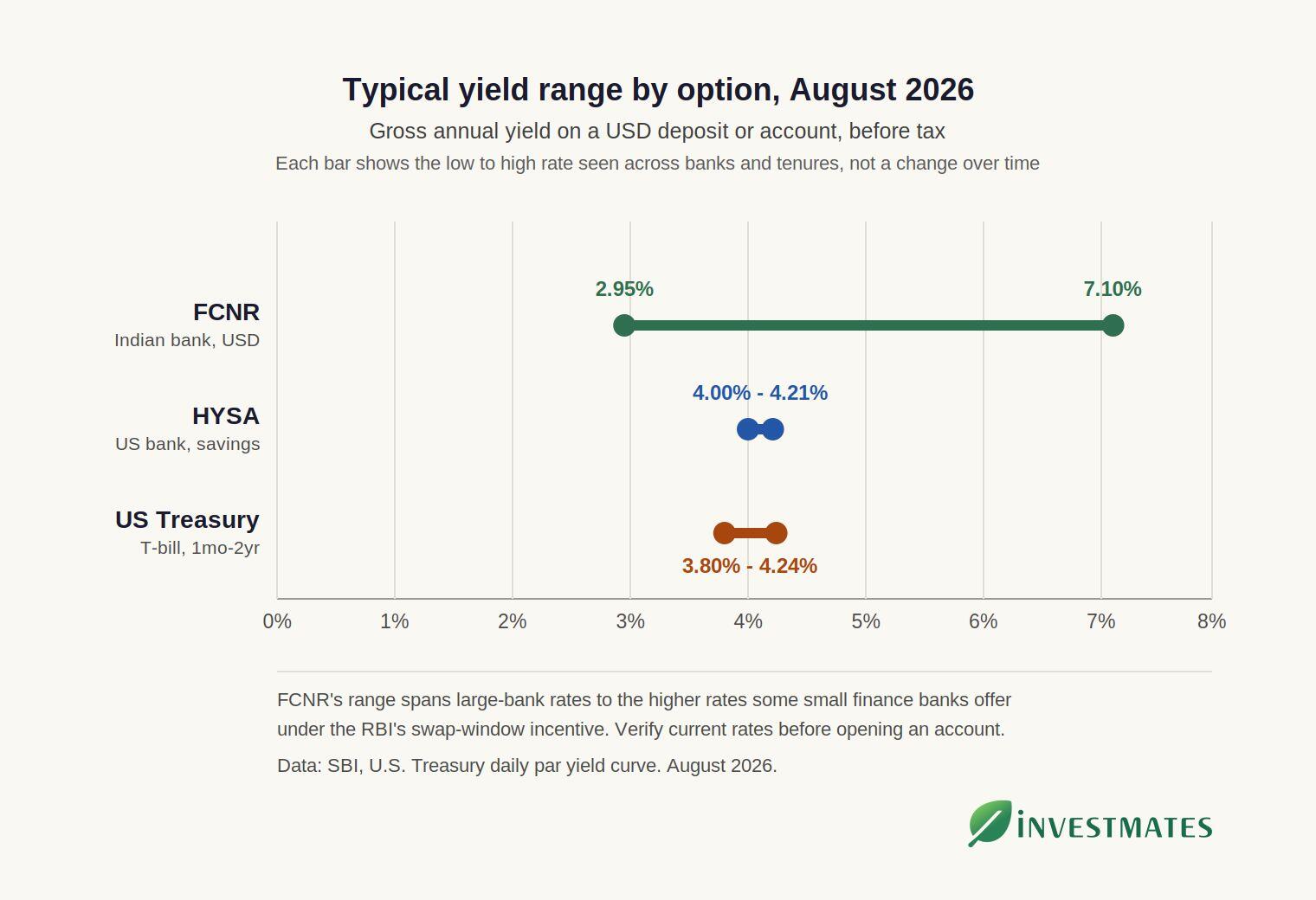
Please note: Data accurate as of August 2026. FCNR and HYSA rates change bank to bank and week to week; verify the current rate before opening anything. Treasury yields come from the Treasury's daily par yield curve, published every trading day.
For most NRIs who are also US taxpayers, the FCNR row that decides this isn't the yield column, it's the one two rows down.
A 7% FCNR rate and a 4.2% HYSA rate land closer together than they look once you've paid US tax on both, because the FCNR side gets no credit for the tax India didn't charge in the first place. The 6.5% to 7.1% rates you'll see quoted at smaller banks are real, driven by the RBI's swap-window incentive, but a rate that good is still only as good as what's left after your US bracket takes its share.
FCNR vs HYSA vs US Treasury: which one should you choose?
There's no single winner here, because the three products are answering different questions. FCNR is a bet on a specific bank's rate for a fixed number of years. HYSA is for money you might need. Treasury bills are for money you want completely safe and don't want locked to one bank.
Choose FCNR if:
- You've confirmed your all-in FCNR rate genuinely beats a HYSA and a Treasury bill after you've accounted for US tax, not before
- You're not a US taxpayer, or you're in a low enough bracket that the missing foreign tax credit barely matters
- You don't mind the money being locked for the tenure, and you're comfortable with DICGC's roughly $6,000 protection ceiling on a deposit that's often much larger
Choose HYSA if:
- You want the money accessible for an emergency fund, a near-term move, or a down payment you can't predict the timing of
- You'd rather not deal with the FBAR filing or Form 8938 paperwork that a foreign account like FCNR triggers
- You want FDIC protection on the full balance without doing currency math
- Your bracket is high enough that you want to shop the after-tax rate, not the sticker rate
Choose US Treasury if:
- You live in a state with meaningful income tax, California and New York both tax at rates that eat straight into a bank rate but not into Treasury interest
- You want zero counterparty risk and don't want to think about deposit insurance ceilings at all
- You're comfortable buying bills yourself through TreasuryDirect or a brokerage, and laddering maturities instead of locking one multi-year rate
Can you use more than one?
Holding two of these at once is usually the right call rather than a failure to decide, and here's how I'd split them. A HYSA holds the true emergency fund, three to six months of expenses, because it has to be available the day you need it.
Treasury bills, laddered across a few maturities, hold the money you know you won't touch for a year or two but still want liquid enough to sell if a better use for it shows up.
FCNR earns a place only for the portion you're genuinely willing to lock away for the full tenure, and only after the after-tax math has actually been run for your bracket and your state.
The bottom line
FCNR, a HYSA, and a Treasury bill are each right for a different job, not competing for the same one.
If you're a US taxpayer holding cash you might need, a HYSA usually keeps more of its rate after tax and skips the FBAR paperwork entirely. If you want the safest possible dollar and a state tax break, ladder Treasury bills.
FCNR earns its place only when you've actually run the after-tax number for your bracket and still come out ahead, and once you run it, I'd expect that group to be smaller than the rate table alone would suggest.
Whichever way you land, check the math against your own state and bracket before you lock a rate anywhere.
Frequently asked questions
Does the interest rate spread between these three ever make FCNR worth the extra paperwork?
Sometimes, mostly for NRIs who aren't US taxpayers, or who are in a low US bracket where losing the foreign tax credit costs less than the extra yield is worth. For a US taxpayer in a high federal bracket and a high tax state, a smaller HYSA or Treasury rate that keeps its full after tax value can beat a bigger FCNR rate that gets taxed twice as hard for no credit in return. Run both after tax before deciding.
Can I open a HYSA or buy Treasury bills while I'm still living in India as an NRI?
You generally need a US address, a US Social Security number or ITIN, and in many cases an existing US bank relationship to open either one, so this mostly applies once you're physically in the US or already hold US accounts from a prior stay. If you're NRI and based in India without US accounts, an NRE or NRO account is the more relevant comparison.