

A cash balance plan is a defined-benefit pension you can set up through a business or practice you own. For the right person, it shelters far more income each year than a 401(k) alone ever will, sometimes past $400,000 when combined with a 401(k) and profit sharing.
It only works if your income is steady and your business can fund it for several years running. Here's what it actually promises, who it's built for, and what happens to that balance the day you try to draw it down from India.
How this defined benefit structure actually works
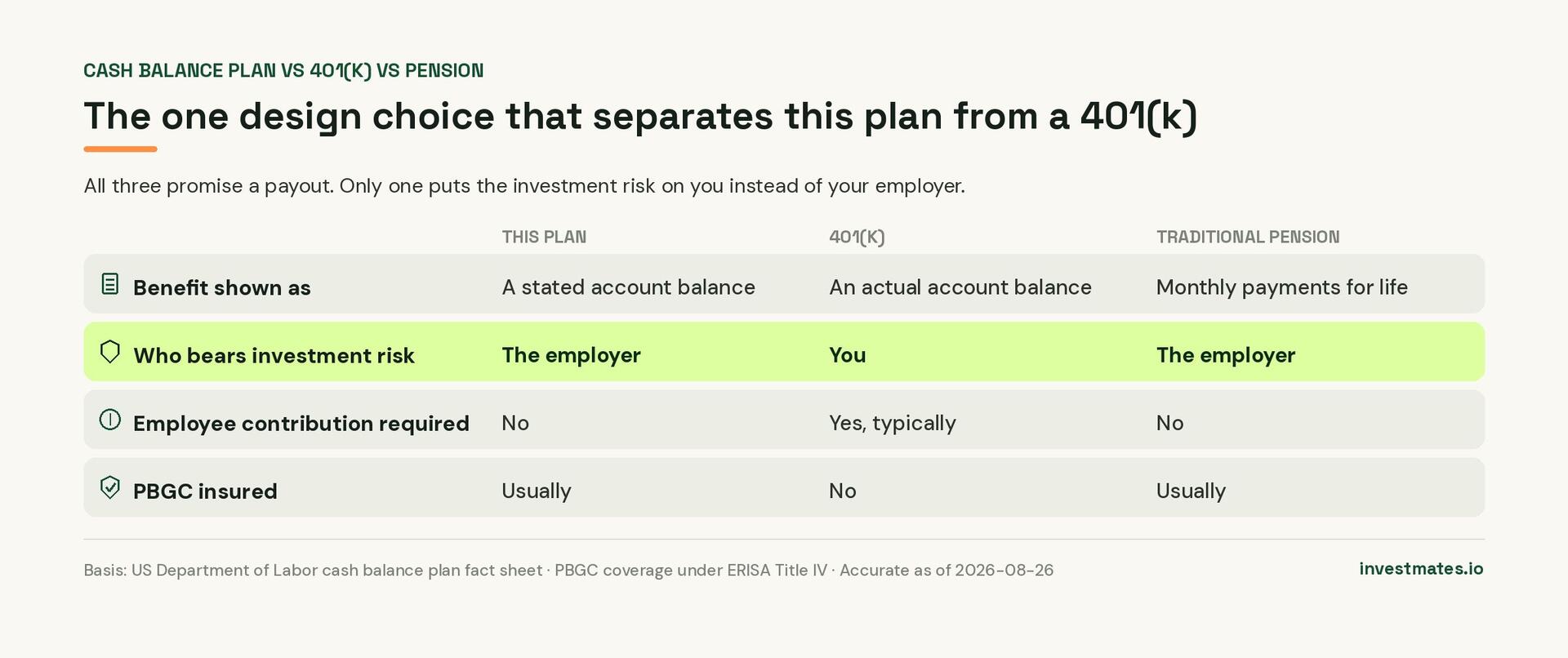
Your account doesn't hold real investments the way a 401(k) does. The Department of Labor describes it as a "hypothetical account."
Each year you get a pay credit, commonly around 5% of compensation, plus an interest credit tied to a rate like the one-year Treasury bill. Your business invests the actual assets and absorbs the gain or loss. You just watch the promised balance grow on paper.
That single design choice, who bears the investment risk, is what separates this plan from a 401(k). It's worth seeing side by side with the traditional pension it's descended from.
You're fully vested after three years of service under Department of Labor rules. The benefit is also portable in a way a traditional pension isn't: when you leave, you roll the balance into an IRA the same way you would a 401(k).
Who a cash balance plan is actually built for
This isn't something you open because you had one great year. It's built for a self-employed professional, consultant, or practice owner, think Schedule C, an S-corp, or a partnership.
Your income has to be high and stay that way, because the IRS expects the arrangement to run for several years. An actuary certifies the funding every year it exists.
The numbers that make it worth the paperwork
For 2026 the Section 415(b) dollar limit on the annual benefit a defined-benefit plan can fund toward is $290,000, up from $280,000 in 2025. The Section 401(a)(17) compensation cap used to calculate it is $360,000.
That 415(b) figure caps the benefit at retirement, not the yearly check you write. That's why the contribution an actuary lets you make climbs sharply the closer you are to retirement.
A standalone 401(k) with profit sharing is capped at $72,000 for 2026 under the separate Section 415(c) limit. Layer this plan on top, and the gap widens fast.
Retirement-plan administrator Carry illustrates someone between 60 and 65 funding $355,000 a year into the plan alone, or up to $435,000 combined with a 401(k) and a reduced profit share. Those figures shift with your age, income, and actuary's assumptions.
The gap that makes this worth the paperwork.
A standalone 401(k) caps out at $72,000 for 2026. Add this plan for someone in their early sixties, and that ceiling can climb to $355,000 alone, or $435,000 combined with a 401(k). The gap opens widest for older, high-earning business owners, since the plan funds toward a fixed benefit and an older participant has fewer years left to get there.
Priya, a self-employed radiologist reading teleradiology contracts as a 1099 consultant, is a typical candidate. She's 58 and nets about $310,000 a year after practice expenses.
She already maxes out a solo 401(k) and has run her consulting business long enough to commit to three more years of funding. An actuary would size her plan contribution well above what the 401(k) alone allows, precisely because her age and income both point the same direction.
What it isn't built for
A single strong year of freelance income with no business structure behind it doesn't fit. Neither does income you expect to swing sharply from year to year.
The funding is designed around a stable, projected contribution. An early termination invites IRS scrutiny of whether the arrangement was ever a genuine retirement vehicle.

It isn't a PFIC, and it doesn't touch FBAR
If you've spent any time reading about what counts as a PFIC for an NRI, it's a fair question to ask whether this carries the same risk. It doesn't.
A PFIC is a foreign fund or foreign insurance wrapper. This is a domestic qualified plan under Section 401(a), held with a US trustee, reported the same way a 401(k) is.
It doesn't sit on your FBAR or Form 8938, because it was never a foreign financial account to begin with.
Who this applies to
Visa and residency status don't decide eligibility here; the source of your income does. An H-1B holder, a green card holder, or a returning NRI running a US-based consulting practice, S-corp, or partnership can all open one on the same terms as a US citizen.
What actually excludes you is being purely a W-2 employee with no business of your own. A plain 401(k) with an employer match, or an IRA, is the right comparison for that situation.
It also doesn't suit anyone whose self-employment income is irregular or expected to drop, since the funding assumes continuity.
What to do about it
Get the funding commitment right first
Talk to a third-party administrator and an actuary before you commit money. The three-year funding runway is the part people underestimate, and unwinding this early is expensive and draws IRS attention.
Decide your eventual payout structure early too, not on the way out the door.
The election that decides your withholding rate
Here's the part that's specific to you as an NRI, and it's the piece I haven't seen any guide on this topic address. I'd treat its payout the same way I treat a 401(k) or IRA distribution once you're a non-resident alien.
DTAA Article 20(1) reads a periodic, annuitized pension stream paid to an India resident as taxable only in India, with 0% US withholding once the custodian accepts a Form W-8BEN citing the treaty.
A single lump-sum payout doesn't qualify as periodic. It falls to Article 23 instead, where the US withholds a flat 30% and India gives credit through the foreign tax credit rather than exempting the income outright.
No court or IRS ruling has addressed this specific plan type's annuity election by name. This is the same treaty reasoning InvestMates already applies to 401(k) and IRA payouts, carried over to a structure that offers the identical annuity option by law.
If you're planning a move back to India, the same RNOR window that lets a returning NRI draw down a 401(k) tax-free in both countries applies here too. Elect periodic payments, get the W-8BEN in before the first distribution, and time the drawdown to your RNOR years.
The one election that decides your withholding rate. Take it as a periodic annuity with the W-8BEN accepted first, and the treaty can bring US withholding to 0%. Take a lump sum instead, and the US withholds a flat 30%. Same balance, same plan, a 30-point swing based purely on how you elect to receive it.
Where this leaves you
If you've got steady self-employment or practice income and you've already maxed out a 401(k), the next real step is a funding illustration from a third-party administrator, not a rate table on a blog.
If a move back to India is anywhere in your plans, decide the payout structure before you retire the practice, not after. That one election is what determines whether the treaty gets you to zero or the IRS gets thirty percent.
I'd rather walk through that election with you before you sign the plan documents than after the first distribution goes out at the wrong rate. Bring the numbers to an advisor while the choice is still open.
Frequently asked questions
Is a cash balance plan the same as a 401(k)?
No. A 401(k) is a defined-contribution plan you fund and invest yourself.
This is a defined-benefit pension where your business promises you a pay credit and an interest credit each year and carries the investment risk itself.
Can an NRI on an H-1B visa open a cash balance plan?
Yes, if the income funding it comes from self-employment, an S-corp, or a partnership you own, rather than W-2 wages from your employer.
Visa status doesn't affect eligibility; the structure of your income does.
Does a cash balance plan count as a PFIC or need FBAR reporting?
No. It's a US-domiciled qualified plan under Section 401(a), not a foreign fund or foreign account.
It falls outside both PFIC and FBAR rules entirely while you hold it.
What happens to a cash balance plan's payout if I move back to India?
It depends on whether you take it as a periodic annuity or a lump sum. A periodic stream can qualify for 0% US withholding under DTAA Article 20(1) once you file Form W-8BEN, while a lump sum is taxed at a flat 30% with no treaty relief.
If the custodian withholds 30% on a periodic payment before your W-8BEN is accepted, you recover it by filing Form 1040-NR the following year.